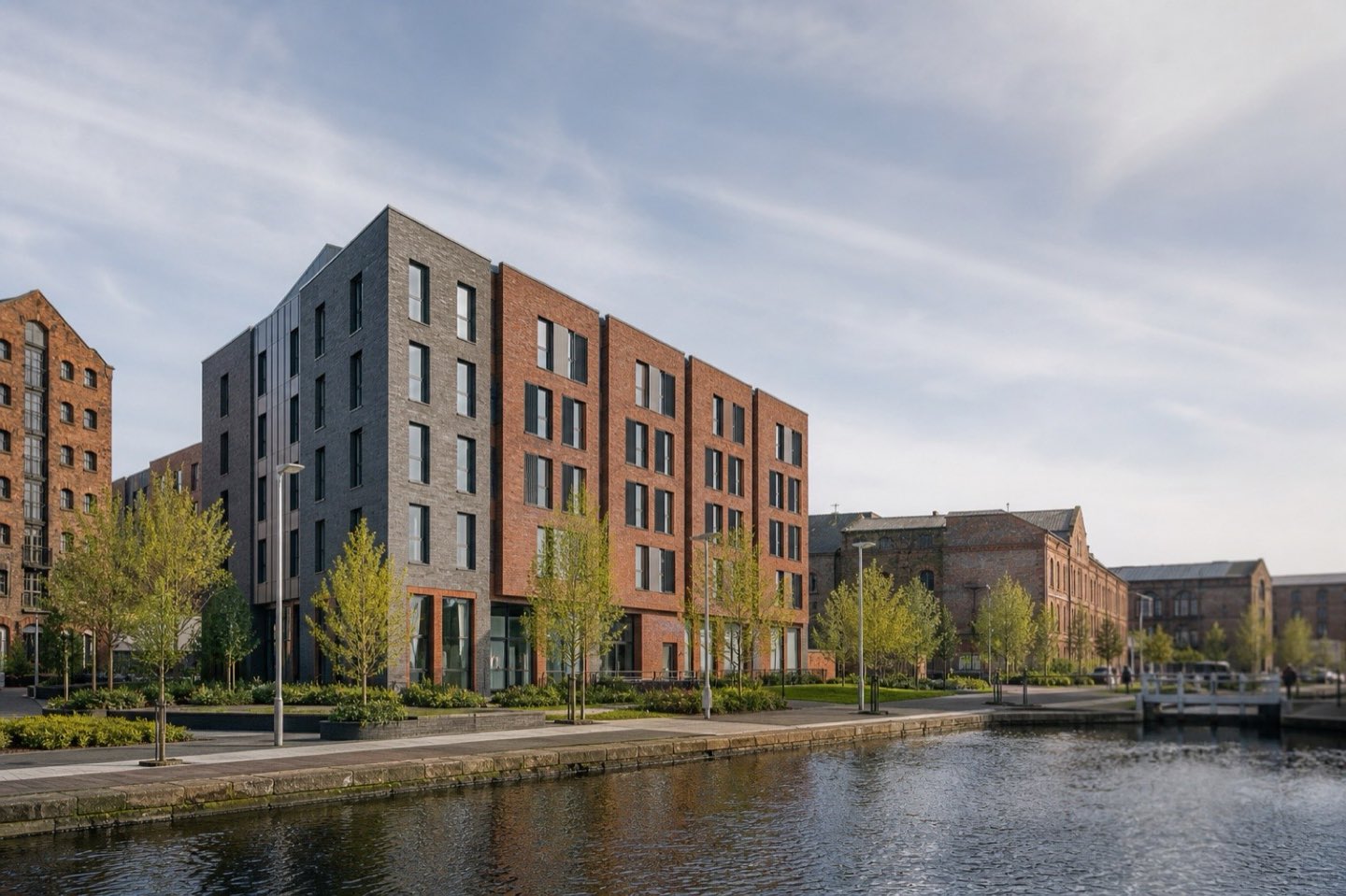
PBSA bridging finance is a short-term commercial loan, indicatively up to 70% loan to value over 3 to 18 months, secured on land or an existing building and repaid from PBSA development finance, a refinance or a sale. It is unregulated commercial lending. We do not arrange regulated bridging on homes that you or your family live in.
What is a student accommodation bridging loan?
A student accommodation bridging loan is short-term secured commercial lending that funds a PBSA site or property until longer-term finance or a sale repays it. The loan is sized on the value of the security, carries a first charge, and is judged as much on the exit as on the asset.
In the PBSA funding sequence, bridging is the first stage. It buys the land or holds it through planning, then student accommodation development finance takes over at construction start. It also appears later in the life of a scheme, wherever speed of funding matters more than price: an auction, a refinance deadline or a conversion that is not yet ready for development funding.
Commercial bridging lenders consider six things on student property development lending, and the exit carries the most weight.
| Test | What they ask |
|---|---|
| Security | The site or property, its current market value and whether a first charge is available |
| Leverage | Indicatively up to 70% of value, lower on land without planning |
| Exit | The development funding, refinance or sale that repays the lending, with evidence |
| Planning and building safety | Where the application stands, the risk of refusal and any Gateway 2 requirement |
| Sponsor | Your track record with PBSA or comparable property, your financial position, liquidity and capital |
| Timing | The term needed, with room for delay, against the academic year the scheme is aiming for |
Indicative only. All lending is subject to status, valuation and lender criteria.
Bridging finance costs more than senior debt such as development finance or term debt, so it only makes sense when the time it buys is worth more than the extra interest. We consider each deal from the development finance exit backwards, weighing the benefits of speed against cost.
We arrange PBSA bridging across England, Wales and Scotland. Lender appetite follows development, which is concentrated in Russell Group cities with deep student demand: around 95% of the beds under construction for 2026/27 are in Russell Group locations (Knight Frank, Q2 2026). A purpose-built scheme is also a different case from an HMO: buying a student HMO or a portfolio of them is a residential investment, while a PBSA bridge is underwritten on the route to a purpose-built block.
Can bridging finance buy a PBSA site ahead of planning?
Bridging finance can buy a PBSA site ahead of planning, and this is its most common use. Development sites for student accommodation sell competitively in a tight property development market, and a vendor will rarely wait for a sui generis student consent, a Section 106 agreement and, for tall buildings in England, a Gateway 2 approval under the Building Safety Act. Bridging finance lets you complete on the land now and carry the project through the planning process.
Lenders value an unconsented site on its existing use or on the planning risk they are prepared to take, not on the value it will have with consent. That keeps the loan well below the purchase price on a pure land deal, so expect to fund more equity or capital than on a site with planning. Where you already hold a resolution to grant, or a consent that only needs amending, land bridging loans can go further. Hampshire Trust Bank, for example, has published a £12.5m bridge refinancing land in Nottingham with PBSA planning consent (Hampshire Trust Bank). Naming a lender here describes the market; it does not mean we have a relationship with it.
A developer agrees to buy a city-centre site for £5m with a planning application for a 300-bed PBSA scheme in progress. A bridging lender values the site at £4m on its current use and lends 70% of that, so £2.8m, for 12 months. The developer funds £2.2m plus costs, secures consent, and repays the bridging finance from the first drawing of a PBSA development finance facility. Round numbers, not an offer of finance.
How do bridging loans fund time-critical purchases of operating student blocks?
Operating PBSA property sometimes comes to market with a tight completion date: at auction, from a receiver, or where a vendor needs certainty within weeks. Term lending banks rarely move that fast; bridging funding can. The plan is to buy with bridging finance, then refinance onto investment finance or a commercial mortgage once the lender's full valuation and diligence are done, or once occupancy has been improved.
For an income-producing block, the bridging lender looks at the existing lettings, current occupancy, the room mix of studio and cluster flat beds, any nomination agreement with a university, how many beds sit under nomination rather than direct let, and the next booking cycle, as well as the building. A block bought after the academic year has started carries that year's income with it; one bought in spring must prove it can let for September. A block with empty beds is either an opportunity or a warning, and lenders will want to know which. A studio-heavy block on direct let income is more exposed to a weak booking cycle, so a lender may size it on a lower occupancy assumption.
When does a bridge to refinance make sense for a PBSA scheme?
A bridge to refinance repays existing loans that fall due before the owner can put long-term debt in place. Common cases are student accommodation development finance maturing before the scheme has traded, a term loan maturing when a sale is under way, or a lender that wants to exit a relationship.
Where the development project is newly completed and letting up, stabilisation finance is often a better fit than a short bridge, because it is senior debt whose term runs through a full letting cycle. Where the asset is already trading at stable occupancy, short bridging financing to a PBSA refinance can be the cheaper answer. Model the step with our stabilisation and refinance calculator.
Can bridging fund an office to PBSA conversion?
Conversions of offices and other commercial property to student accommodation are a real route to new beds in city centres, and bridging finance often funds the purchase. Pluto Finance, for example, provided a £12.5m bridge-to-development loan for an office to PBSA conversion in Leeds (Pluto Finance, December 2024). Deep office floor plates can be hard to plan as studio or cluster flat layouts with enough daylight, which drives the bed count and the value lenders see. Two further points shape the development project and its funding.
- Planning. Class MA permitted development allows a change from Class E commercial use to Class C3 dwellinghouses. A PBSA scheme of cluster flats is usually a sui generis use, so an office to student accommodation conversion generally needs a full planning application rather than relying on permitted development. See our guide to PBSA planning and use class.
- Building safety. Converting a building of at least 18 metres or seven storeys to create two or more residential units brings it into the higher-risk building regime in England, and building work needs Building Safety Regulator approval at Gateway 2. The regulator reported a median approval time of 22 weeks for new higher-risk buildings and conversions in May to July 2026 (Building Safety Regulator, August 2026).
A light refurbishment project can sometimes use refurbishment bridging financing. A heavy conversion with structural works usually moves onto student accommodation development finance once consent and Gateway 2 are in place, with the bridge covering the purchase and the planning period.
How does a bridge hand over to student accommodation development finance?
Most PBSA bridging loans on land are repaid by student accommodation development finance. The PBSA development finance lender refinances the bridge with its senior debt at construction start, usually as part of its first drawing, and counts the land in the project's total development cost. Where the land has risen in value with planning, some development lenders accept part of that uplift as equity, which reduces the cash the developer has to put into the project.
The hand-over only works if the development finance application is approved before the bridge falls due. We line up both at the start: the bridging loan term is set against the planning timetable, the Gateway 2 timetable and the academic year the scheme is aiming for, and the PBSA development funding lender sees the project before the bridge completes. That avoids an expensive extension, or a second bridge, while the construction loan is still in credit.
| Funding | Typical use | Indicative leverage and term |
|---|---|---|
| Bridging finance | Site purchase, auction, refinance deadline, conversion purchase | Up to 70% LTV, 3 to 18 months |
| Student accommodation development finance | Construction of a new scheme or heavy conversion | 60 to 70% LTC, capped at 60 to 65% of GDV |
| Stabilisation finance | Lease-up after practical completion | 60 to 70% of value, 12 to 36 months |
| Investment debt and commercial mortgages | Holding a let, trading block | 55 to 65% LTV, 3 to 7 years |
Indicative only, not an offer of finance. All lending is subject to status, valuation and lender criteria.
These PBSA finance products sit in one property development sequence, and choosing the right one at each stage is the main decision. Bridging loans buy time and speed; student accommodation development finance funds the build; commercial mortgages and investment loans hold the finished asset. Read more about PBSA development finance.
What does PBSA short-term finance cost, and what are the downsides?
Bridging finance is priced above development finance and term lending, and the headline rate is only part of the cost of the funding. Compare total cost, not the monthly rate.
- Interest: charged monthly, usually rolled up or retained from the advance.
- Arrangement fee: charged by the lender and usually added to the loan.
- Exit fee: charged by some lenders on repayment; others charge none.
- Valuation and legal costs: yours and the lender's, paid whether or not you borrow.
- Default interest: a higher rate if the loan is not repaid on time.
A bridging loan to an individual or trustees, secured on residential property where at least 40% is used as a dwelling by the borrower or a related person, is generally a regulated mortgage contract under Financial Conduct Authority rules (FCA Handbook, PERG 4.4). We do not arrange that kind of bridging. PBSA bridging loans are unregulated commercial lending to property developers, real estate investors and business borrowers, and we refer anything that needs FCA authorisation to a regulated firm.
Questions
How much would a £200k bridging loan cost?
What is a PBSA scheme?
What are the downsides of a bridging loan?
Is PBSA bridging finance regulated?
How quickly can a PBSA bridging loan complete?
- Knight Frank, UK Student Market Update Q2 2026
- FCA Handbook, PERG 4.4: What is a regulated mortgage contract?
- The Town and Country Planning (General Permitted Development etc.) (England) (Amendment) Order 2021, Class MA
- Lichfields, New Class MA: commercial to residential permitted development, 2021
- Building Safety Regulator, building control approval application data, May to July 2026
- Hampshire Trust Bank, £12.5m bridge refinancing land with PBSA planning
- Pluto Finance, £12.5m loan for PBSA development in Leeds, December 2024
 Written and reviewed by Matt Lenzie, Founder and principal. Last reviewed .