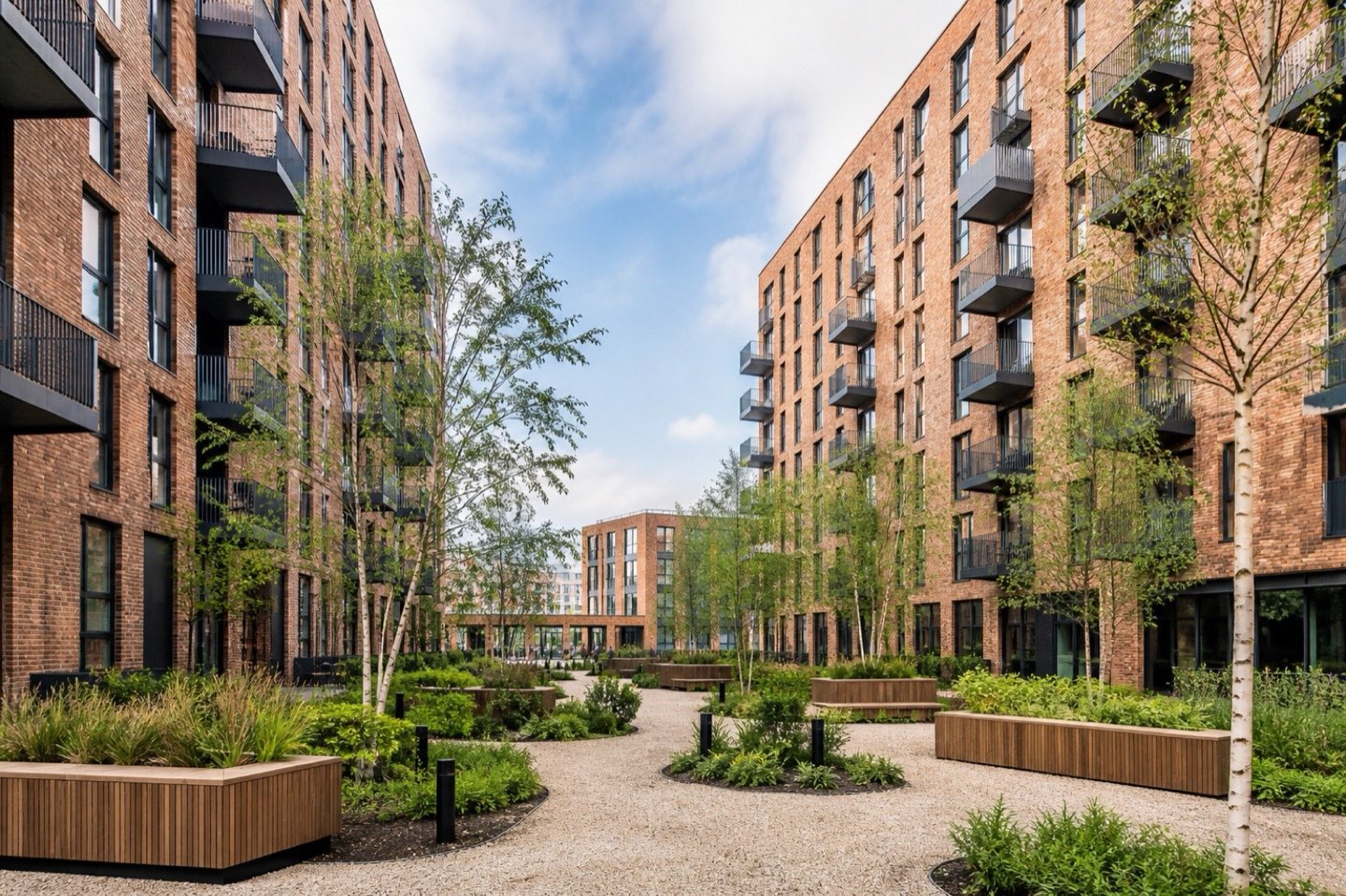
A PBSA scheme is a single managed building of studio and cluster flat rooms, planned and let for students rather than converted from ordinary housing. It is owned by listed companies, funds, universities and developers, run by specialist operators, and financed in stages from site purchase to long-term investment debt. Not to be confused with other uses of the acronym, such as a power-tool model code or the US Professional Background Screening Association.
What does PBSA mean in property and real estate?
PBSA (purpose-built student accommodation) is residential property built for the sole purpose of housing students. You will also see it written as purpose built student accommodation, without the hyphen, or simply as student housing. The building is designed around student living from the start: bedrooms grouped into flats or studios, shared kitchens, study and social space, secure entry and an on-site management team.
In real estate, PBSA is treated as an operational asset class within the wider living sector, alongside hotels, build to rent and care homes, and a real estate portfolio of student beds is valued much like a hotel portfolio. Its value comes from the income it earns rather than from selling individual units, so owners and lenders talk about rent per bed per week, occupancy, operating costs and net operating income. A private block leased or let to students is PBSA; so is a modern university hall, whether the university owns it or a private partner does.
Two things set purpose-built student housing apart from the rest of the private rented sector. It is let by the bed, on a room-by-room contract for the academic year, and it is usually managed by a specialist operator rather than a landlord. Rent normally includes bills, wifi and contents insurance, so the weekly price covers the whole stay, and the building is designed around student life: study, sleep and a social space in a city-centre or campus location.
A PBSA scheme is a single development of student rooms, typically from around 100 to over 1,000 beds, with its own planning permission, management plan and operator. 'Scheme' is the word developers, planners and lenders use for the building as a project, from site to operation.
How is purpose-built student housing different from halls and HMOs?
Purpose-built student housing differs from university halls and HMOs in who owns it, who lets it and how it is regulated.
UK students who leave home live in one of three places: university halls, private PBSA, or shared houses in the private rented sector, most of which are HMOs (houses in multiple occupation).
| University halls | Private PBSA | Student HMO | |
|---|---|---|---|
| Owner | University, or a private partner on a long lease | Listed companies, funds, developers | Private landlords |
| Who lets it | University accommodation office | Operator, direct to students or via a university | Landlord or letting agent |
| Building | Purpose-built, on or near campus | Purpose-built, often in the city centre | Converted house or flat |
| Typical tenant | First-year students | First-years, returners, postgraduates, international students | Returning students in friendship groups |
| Regulation | University code of practice | Planning conditions, approved code of practice | HMO licensing and Article 4 directions |
Modern halls are themselves purpose-built, so the line between halls and private PBSA is about ownership and letting rather than design. The line with HMOs is sharper: an HMO is ordinary housing adapted for sharing, licensed by the council. We compare the two in detail in PBSA vs student HMO.
What does a student accommodation scheme include?
A student accommodation scheme includes private bedrooms, shared or self-contained kitchens, amenity space and on-site management.
Room types: studios, cluster flats and townhouses
- Cluster flats: four to eight en-suite bedrooms sharing a kitchen and living room. The most common format and the lowest rent per bed.
- Studios: self-contained rooms with a kitchenette and shower room. Popular with postgraduate and international students, a studio lets at a premium rent and costs more to build per bed.
- Townhouses: small shared houses within a larger campus-style scheme, usually five to ten bedrooms over several floors.
- Amenity space: gyms, study rooms, cinema and social space, laundry and a reception. It earns no rent directly but supports occupancy and rebooking.
Direct let vs nominations
A scheme earns income in one of two ways. Under direct let, the operator markets rooms and signs contracts with students each year, taking the letting risk for market rent. Under a nomination agreement, a university reserves a block of rooms, sometimes for 20 years or more, and fills them or pays for them. Nominations give security of income; direct let gives rental growth. Many schemes mix both. See nomination agreements vs direct let.
What is PBSA management?
PBSA management is the operation of a scheme: marketing and letting, pricing each booking cycle, rent collection, maintenance, cleaning, security, fire safety, student welfare and compliance with an approved code of practice. Owners either run their own buildings or appoint a third-party operator on a management agreement, typically for a fee linked to income. The operator's record is one of the first things a lender or valuer reviews.
Who owns and operates PBSA in the UK?
The UK PBSA sector is owned mainly by institutional capital. Unite Students, part of the listed Unite Group, describes itself as the UK's largest provider of student accommodation, with 71,000 beds across 29 cities after completing its purchase of Empiric Student Property in January 2026 (Unite Group, January 2026). iQ Student Accommodation has been owned by Blackstone since a £4.66bn acquisition in 2020 (Kirkland & Ellis, 2020).
Other large owners and operators include Greystar, Student Roost, Scape, Yugo, Homes for Students, Fresh, CRM and Downing Students, alongside universities, pension funds, sovereign wealth and private equity investors, and local developers whose PBSA developments are built to sell on completion. Universities also partner with private capital: Knight Frank recorded a joint venture with Manchester Metropolitan University of around £390m covering 2,300 beds in Q1 2026 (Knight Frank, Q1 2026). Our guide to the biggest PBSA providers in the UK sets out the sourced figures.
How big is the UK student accommodation market?
Demand is still growing: a record 695,740 applicants had applied to UK universities by the June 2026 UCAS deadline, up 4% on the year (Knight Frank, Q2 2026, citing UCAS), and a record 446,690 applicants had been accepted by results day in August 2026 (UCAS, August 2026). Savills found 2.7 full-time students for every PBSA bed across 20 major markets (Savills, April 2024), which is why the sector has long been described as undersupplied.
Supply is growing, but slowly. Knight Frank counted 19,200 new beds delivered in 2025, 81% of them in Russell Group cities, with around 19,000 under construction for the 2026/27 academic year (Knight Frank, Q2 2026). But the market has cooled. Rental growth across all room types slowed to 2% in 2025/26, down from 8.3% at the peak (Knight Frank, 2025/26), and occupancy across the wider sector averaged around 86%, with vacancies concentrated in cities that saw heavy new supply (Unite Group, February 2026). Prime direct-let yields in London are around 4.75% net initial yield, with regional prime at about 5.50 to 5.75% (Knight Frank, Q2 2026).
The largest student markets outside London include Manchester, Birmingham, Leeds, Bristol, Nottingham, Newcastle and Glasgow, each with its own balance of students to beds. Supply is not uniform: Unite reported its vacancies concentrated in Leicester, Nottingham and Sheffield in 2025/26 (Unite Group, February 2026).
For the full picture, including pipeline and investment trends, read our UK PBSA market guide or track city-level data in the PBSA Capital Monitor.
How are PBSA developments planned and regulated?
Planning permission and use class
In England, larger PBSA schemes are usually treated as sui generis, a use outside the standard use classes, rather than as ordinary housing. Planning permission typically comes with a Section 106 agreement restricting occupation to students and a student management plan. Some councils set local policies on location, concentration and affordable student rooms, such as Policy H15 of the London Plan. See PBSA planning and use class.
Building Safety Act
Student accommodation at least 18 metres or seven storeys tall with two or more residential units is a higher-risk building under the Building Safety Act 2022. The Building Safety Regulator must approve the design at Gateway 2 before work starts. The median approval time for new higher-risk buildings was 22 weeks in the 12 weeks to August 2026, down from 43 weeks a year earlier (Building Safety Regulator, May to July 2026). Timing now drives programmes for new PBSA developments and finance drawdown; see the Building Safety Act and Gateway 2.
Renters' Rights Act
Tenancy reforms under the Renters' Rights Act 2025 took effect in England on 1 May 2026. Purpose-built student accommodation run by a member of an approved code, such as the ANUK/Unipol Code, can let outside the new assured periodic tenancy regime (Unipol, 2026). Read our Renters' Rights Act guide for what that means for owners and lenders.
How is a PBSA development financed?
A student accommodation scheme is financed in stages, because its risk changes as it moves from a site with planning to a trading building. Lenders size each stage differently: on cost during construction, then on valuation and income once the building is let. Value matters at every step. A PBSA valuation capitalises net operating income at a market yield, cross-checked against value per bed and comparable city transactions, and the lender's valuation sets the ceiling on debt at each stage of the PBSA sector's funding cycle; see PBSA valuations.
Mezzanine and joint-venture equity can close the gap between senior debt and a sponsor's equity. Indicative development debt runs at 60 to 70% loan to cost and investment debt at 55 to 65% LTV, priced over SONIA or the swap rate according to leverage, stage and sponsor, and always subject to status, valuation and lender criteria. We arrange this finance; we are not a lender. To test numbers on a scheme, try the development appraisal tool.
PBSA guides
Questions
What is a PBSA?
What does PBSA stand for?
Is PBSA the same as university halls?
What is PBSA management?
Who are the biggest PBSA providers in the UK?
Is PBSA a good investment?
What is the current state of the UK PBSA market?
- UCAS, Quarter of a million UK 18-year-olds gain place at university or college, 13 August 2026
- BONARD, UK PBSA Report 2026, September 2026
- Savills, UK cities need much higher rates of student housing delivery, April 2024
- Knight Frank, UK Student Accommodation Outlook 2025/26
- Unite Group, 2025 full-year results statement, February 2026
- Knight Frank, UK Student Market Update Q4 2025 (February 2026)
- Knight Frank, UK Student Market Update Q2 2026
- Knight Frank, UK Student Market Update Q1 2026
- Unite Group, Unite Group completes purchase of Empiric Student Property, January 2026
- Kirkland & Ellis, Blackstone's £4.66 billion acquisition of iQ Student Accommodation, 2020
- Building Safety Regulator, building control approval application data, May to July 2026
- Unipol, Students in private sector purpose-built accommodation (Renters' Rights Act 2025)
- Building Safety Act 2022
 Written and reviewed by Matt Lenzie, Founder and principal. Last reviewed .