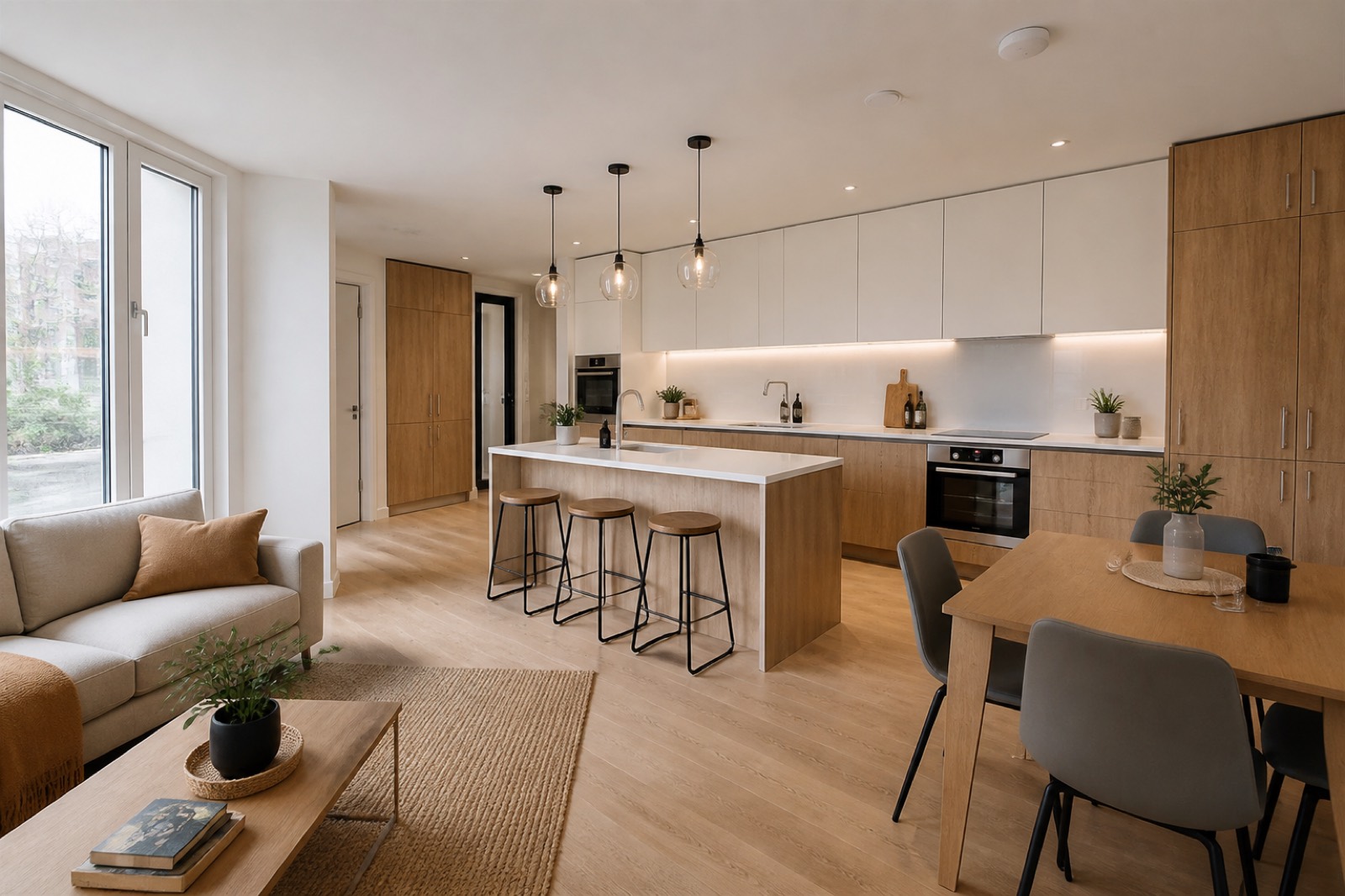
A student HMO is a house shared by three or more unrelated people, licensed by the council and usually owned by a private landlord. PBSA is a single managed building designed for students, planned as its own use and funded like commercial property. The PBSA vs HMO difference shows most clearly in regulation, finance and who owns each.
What is the difference between PBSA and an HMO?
Purpose-built student accommodation is a building designed, built and operated for students, usually a block of studios and cluster flats with shared amenity space, managed on site and let room by room for the academic year. Most schemes hold from around 100 to over 1,000 beds.
A house in multiple occupation is a property let to three or more people who form more than one household and share a kitchen or bathroom (Housing Act 2004, section 254). A typical student HMO is a terraced or semi-detached house converted to four to six bedrooms, let to a group of friends on a joint tenancy.
Both are forms of student accommodation. PBSA and HMO landlords both let to students on university courses. The difference is scale and purpose. PBSA is one asset whose design starts from student living; HMO properties are ordinary houses adapted for sharing. That distinction flows through planning, licensing, safety, finance and the kind of investor who owns each.
We arrange finance for PBSA schemes and portfolios. For student HMO and co-living finance, our sister site studentaccommodationfinance.co.uk covers that market.
Purpose-built student accommodation and shared houses: a head-to-head comparison
| PBSA | Student HMO | |
|---|---|---|
| Building | Purpose-built block, often 100 to 1,000+ beds | Converted house or flat, typically 3 to 8 bedrooms |
| Room types | A studio or an en-suite bedroom in a cluster flat, some townhouses | Bedrooms, sometimes en-suite, with a shared kitchen and living room |
| Tenancy | Individual room contract for the academic year | Often a joint tenancy for the whole house |
| Bills | Usually included in the rent | Sometimes included, often paid by tenants |
| Management | On-site team, security and amenity space | Landlord or letting agent, visits as needed |
| Planning | Usually sui generis, with a student management plan | Use class C4 (3 to 6 people) or sui generis (7 or more) |
| Licensing | Block of 3+ purpose-built flats sits outside mandatory HMO licensing | Mandatory licence at 5+ people; councils may add additional licensing |
| Building safety | Taller schemes are higher-risk buildings under the Building Safety Act | Housing Health and Safety Rating System and HMO fire safety standards |
| Typical owner | Institutions, listed REITs, private equity and developers | Private landlords and small portfolio owners |
| Finance | Development, stabilisation and investment debt sized on cost and income | HMO mortgages and buy-to-let style loans sized on value and rent |
General comparison for England. Local licensing schemes, Article 4 directions and planning policies vary by council.
For a student, the choice is usually about price, social life, location and the bills-included convenience of PBSA against the independence of a shared house. For an owner or lender, the questions are different: how the asset is regulated, how it earns its income and how it is valued.
How are student HMOs regulated compared with PBSA?
HMO licensing
Since October 2018, any HMO in England occupied by five or more people forming two or more households needs a mandatory licence from the council, whatever the number of storeys. Councils can also designate additional licensing areas that catch smaller HMOs, which is common in student areas, and a licence can set room sizes, amenity standards and occupancy limits.
Purpose-built blocks are treated differently. The mandatory licensing order excludes a flat in a purpose-built block of three or more self-contained flats, so the cluster flats in a typical PBSA scheme sit outside mandatory HMO licensing. Instead, PBSA operators commonly sign up to an approved code of management practice, such as the ANUK/Unipol National Code for larger developments.
Article 4 directions
Converting a family house (use class C3) into a small HMO (C4) is normally permitted development. Many university towns and cities have used an Article 4 direction to remove that right in student areas, so each new HMO needs planning permission and can be refused where concentrations are already high. Large HMOs of seven or more people are sui generis and always need permission.
These controls limit the growth of HMO supply and are one reason councils steer student demand toward managed purpose-built schemes, often through local plan policies that favour PBSA in city centres. See PBSA planning and use class for how those policies work.
Tenancy reform and building safety
The Renters' Rights Act 2025 affects both. It includes a possession ground, Ground 4A, so that landlords of student HMOs can recover a property for a new group of students in line with the academic year. Purpose-built student accommodation is treated differently: where the landlord or manager is a member of an approved code, such as the ANUK/Unipol Code of Standards for Larger Developments, the tenancy is not an assured tenancy (Student Accommodation (Miscellaneous Provisions) (England) Regulations 2026); our Renters' Rights Act guide covers the detail. On safety, taller PBSA schemes are higher-risk buildings under the Building Safety Act 2022, with approval gateways before construction and occupation, while HMOs are assessed under the Housing Health and Safety Rating System and HMO fire safety standards.
How does financing PBSA differ from HMO finance?
HMO finance is residential-style lending. A landlord borrows on a specialist HMO or buy-to-let mortgage, sized against the property's value and tested against the rent, often with a personal guarantee. Loans are small, products are standardised and the lender's main questions are the licence, the room sizes and the rent roll.
PBSA finance is commercial real estate lending. A developer borrows development finance against total cost and gross development value, then moves to stabilisation and investment debt once the building trades. Lenders underwrite the operator, the university market, the planning consent and the net operating income, and the building is valued on its income rather than on comparable house prices.
| Question | Student HMO lender | PBSA lender |
|---|---|---|
| How is the loan sized? | Loan to value and rental cover | Loan to cost, then loan to value, ICR or debt yield |
| How is the asset valued? | Bricks and mortar or investment value on the rent | Capitalised net operating income, per bed cross-checks |
| Who is the borrower? | Individual or small company landlord | SPV owned by a developer, fund or operator |
| What drives risk? | Licence, void rooms, tenant arrears | Build cost, planning, occupancy, operator, exit |
Indicative comparison only. All lending is subject to status, valuation and lender criteria.
Indicative PBSA bands on this site run from 60 to 70% loan to cost for development to 55 to 65% LTV for term debt, subject to status, valuation and lender criteria. For the full sequence, see PBSA finance by stage or test a scheme in our debt sizing tool.
How does property management differ between a scheme and a shared house?
Property management is where the two models feel most different day to day. In a purpose-built scheme, a professional operator runs a reception, security, cleaning of common areas, maintenance teams and a booking platform, and bundles bills, wifi and contents insurance into one weekly rent. Maintenance issues are logged and fixed on site, often the same day.
In HMO properties, the landlord or a letting agent provides the service. Quality varies widely: a well-run student property portfolio can be high quality and good value for money, while a poorly managed house can leave tenants waiting on repairs. The landlord's time and resources, rather than a dedicated site team, set the standard, and some landlords choose to manage the houses themselves.
For lenders, the operating model matters because it drives cost. A PBSA operator's fees, staffing and lifecycle spend sit between gross rent and net operating income, so the gross-to-net on a purpose-built scheme is higher than on a shared house, but the income is more scalable and easier to underwrite across hundreds of beds.
PBSA vs HMO: which is the better student property investment?
PBSA and HMOs suit different investors, and neither is better in the abstract. We do not give investment advice. The profiles differ in four ways.
- Ticket size. A single student HMO can be bought for a few hundred thousand pounds. A PBSA scheme is usually a multi-million pound asset, which is why institutions, REITs and private equity own most of the stock.
- Management. An HMO landlord or agent manages a handful of tenants. PBSA needs an operator with booking systems, on-site staff and compliance teams, and the operator's fee sits inside the gross-to-net.
- Supply constraints. Article 4 directions and licensing limit new HMO supply, while PBSA supply depends on planning, construction cost and building safety approvals.
- Liquidity. PBSA trades in a deep institutional market; Knight Frank recorded £4.3bn of UK PBSA investment in 2025 (Knight Frank, February 2026). Student HMOs trade one house at a time, usually to other landlords.
Regulatory changes affect both sides. Licensing, Article 4 and the Renters' Rights Act raise the cost of running HMOs, while building safety rules raise the cost of delivering tall PBSA. For further reading on the relevant topics, see is PBSA a good investment? and our view of the UK PBSA market.
Why are students choosing purpose-built student housing?
Demand drivers help explain why the two markets coexist. Purpose-built schemes suit first-year students living away from home for the first time, and international students, who want a single contract, bills included, security and a ready-made community. Shared houses suit returning students who want to live with friends, often at a lower rent per room.
The student decision between PBSA and HMO living usually turns on five things:
- Cost. PBSA rent is usually higher per week but includes bills; HMO rent can be lower, with bills on top.
- Amenities. Purpose-built schemes offer gyms, study space and common rooms; a shared house offers a kitchen and living room.
- Community and social experience. A large scheme puts hundreds of students under one roof with organised events, which suits students who want a social stay in their first year. An HMO gives a smaller, self-chosen group.
- Location. PBSA clusters in city centres and near campuses; student HMOs sit in established residential neighbourhoods.
- Safety and security. Staffed reception, CCTV and controlled entry are standard in PBSA; in an HMO they depend on the landlord.
Neither option is better for every student. The social and location trade-offs that shape a student's choice also shape rental demand, which is why lenders read both markets when they assess a PBSA scheme.
Recent research points to a market that is still changing. Knight Frank reports that 35% of June 2026 UCAS applicants said they intended to live at home, up one percentage point on the year, a proxy for affordability pressure (Knight Frank, Q2 2026). Supply has shifted too. Savills found 2.7 full-time students for every PBSA bed across 20 major markets (Savills, April 2024). The rest of the student population lives at home, in university halls, or in the private rented sector, much of it in HMOs. Where Article 4 directions and licensing restrict HMOs, the gap between student numbers and available rooms tends to fall on PBSA.
Questions
What is classed as PBSA?
Do student houses count as HMOs?
Do I need a HMO licence for 4 bedrooms?
Can a 2 bedroom flat be a HMO?
Is a PBSA cluster flat an HMO?
- Housing Act 2004, section 254 (meaning of house in multiple occupation)
- The Licensing of Houses in Multiple Occupation (Prescribed Description) (England) Order 2018
- GOV.UK, Houses in multiple occupation and residential property licensing reform
- Knight Frank, Investors committed £4.3 billion to the PBSA market in 2025 (February 2026)
- Savills, UK cities need much higher rates of student housing delivery, April 2024
- Renters' Rights Act 2025, Schedule 1 (Ground 4A)
- The Student Accommodation (Miscellaneous Provisions) (England) Regulations 2026 (SI 2026/327)
- Knight Frank, UK Student Market Update Q2 2026
- Building Safety Act 2022
 Written and reviewed by Matt Lenzie, Founder and principal. Last reviewed .