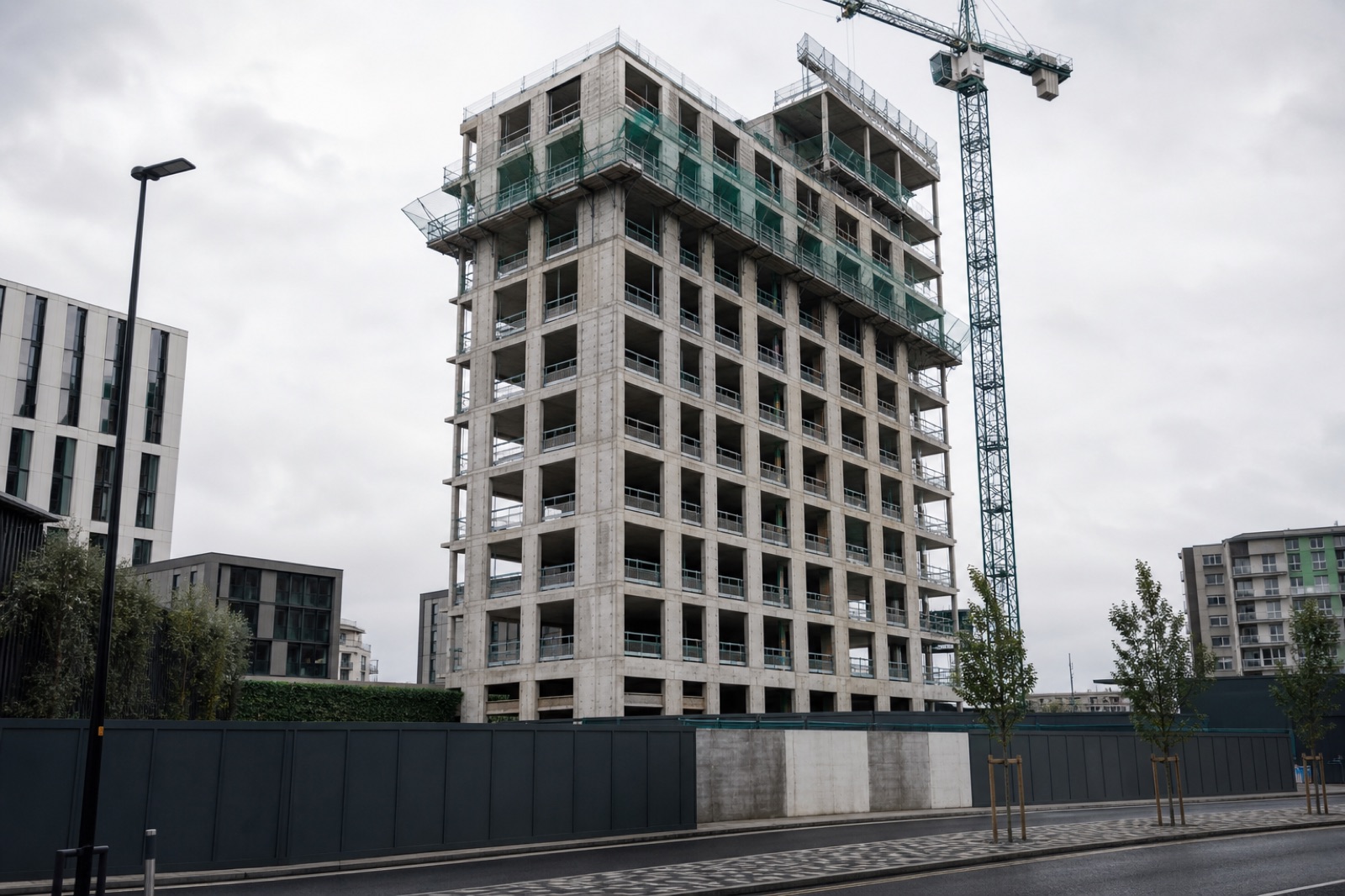
A student block of at least 18 metres or seven storeys with two or more residential units is a higher-risk building. It needs Building Safety Regulator approval at Gateway 2 before work starts and a completion certificate at Gateway 3 before occupation. New-build Gateway 2 approvals took a median 22 weeks in June to August 2026, against a 12-week statutory period, and the new Building Safety Levy applies from 1 October 2026.
Does the Building Safety Act apply to purpose-built student accommodation?
The Building Safety Act 2022 applies to student accommodation (PBSA) in the same way as to blocks of flats. The legislation followed the Grenfell Tower fire of June 2017 and Dame Judith Hackitt's Independent Review of Building Regulations and Fire Safety, received Royal Assent in April 2022, and created a new regime for the design, construction and occupation of taller residential buildings. During design and construction, under section 120D of the Building Act 1984, a higher-risk building is one that is at least 18 metres high or has at least seven storeys and contains at least two residential units, or is a care home or hospital (Higher-Risk Buildings (Descriptions and Supplementary Provisions) Regulations 2023, SI 2023/275).
Those regulations define a residential unit as a dwelling or any other unit of living accommodation. Government guidance confirms that shared accommodation within university halls, such as a bedroom with a shared kitchen and bathroom, counts as residential units (GOV.UK, May 2025). Buildings used entirely as hotels are excluded, but student accommodation is not. In practice, almost every PBSA tower in England, whatever its number of beds, falls within the regime; low-rise schemes below both thresholds do not. Most student HMOs are converted houses well below 18 metres and seven storeys, so they sit outside the higher-risk regime, although HMO licensing and fire safety rules still apply. For developers and owners, that makes the building safety route part of project viability from the first sketch, not a technical step after planning, and its impact on delivery timelines puts pressure on every programme.
The higher-risk building regime described here applies in England. Scotland and Wales run separate building standards systems.
What are Gateways 1, 2 and 3 for a student housing scheme?
The building safety gateways are three approval points that a higher-risk building must pass, from planning to occupation. The Building Safety Regulator (BSR) is the building control authority for these buildings, and since 27 January 2026 it has been a standalone body rather than part of the Health and Safety Executive (SI 2026/20).
- 1Gateway 1: planningFor planning applications made from 1 August 2021, a fire statement is submitted with the application for relevant buildings, which expressly include residential accommodation for students (SI 2021/746), and fire safety matters that affect land use planning are assessed by the statutory consultee.
- 2Gateway 2: before constructionBuilding control approval must be obtained from the BSR before building work starts. The BSR has up to 12 weeks for a new higher-risk building, or eight weeks for work to an existing one (Forsters, 2023).
- 3Construction and change controlMajor changes to the approved design need further BSR approval, and the client must keep the golden thread of building information up to date.
- 4Gateway 3: before occupationThe BSR must issue a completion certificate, with a statutory period of eight weeks, before the building can be registered and occupied (SI 2023/909).
For development finance, Gateway 2 is the one that matters most. Construction cannot start without it, so the lender cannot fund build costs, and the programme to practical completion and the September opening date cannot be fixed until the approval date is known.
How long is Gateway 2 taking for new higher-risk buildings?
Gateway 2 has run well beyond the 12-week statutory period, although times have improved through 2026. Delays have been one of the biggest concerns for the residential and student housing development sector since the regime began. The BSR's own data shows new-build approvals improving sharply since it set up an Innovation Unit for new-build applications in August 2025.
In the 12 weeks to August 2025, only 39% of new-build decisions were approvals. In June to August 2026, 46 of 50 decisions were approvals, although complex cases, tracked separately, had a median approval time of 33 weeks, and 147 new-build and conversion applications were in progress (Building Safety Regulator, data to 31 August 2026). The regulator's 2026 to 2027 strategic plan targets 18 weeks or less for non-complex new-build applications by March 2027. Unite Group has said the gateways add 6 to 12 months to development programmes (Unite Group, 2025 results).
The latest government figures are published monthly, so check them when you set the project programme. For a student accommodation developer, a 22-week approval against a 12-week plan is ten extra weeks of site holding costs and interest, and it can push the practical completion date past the start of an academic year. That single slip can leave the beds empty until the following academic year and cost most of a year's income.
What does the second staircase change mean for tall student blocks?
Amended guidance in Approved Document B expects a second common staircase in new blocks of flats with a top storey at 18 metres or more. MHCLG Circular 04/2024 announced updated guidance on second staircases in blocks of flats with a storey 18m or more in height, together with evacuation lifts, taking effect on 30 September 2026.
The transitional rule is narrow. The previous guidance continues to apply only where a building notice, initial notice or full plans application was made before 30 September 2026 and the work is sufficiently progressed, meaning foundations or piling have started, by 30 March 2028 (MHCLG Circular 04/2024).
A second stair takes net lettable area out of every floor, so on a tall PBSA scheme it reduces the number of beds, the income and the gross development value, while adding cost. The circular does not name PBSA. Approved Document B does, however, address student residences designed and occupied as blocks of flats (Volume 1, paragraph 1.11, and Volume 2, paragraph 1.18), so cluster-flat and studio schemes may well be caught. Confirm the classification with the fire engineer and the BSR; lenders expect the fire strategy to answer it before they commit.
Is PBSA subject to the Building Safety Levy?
The Building Safety Levy is a charge on new residential buildings in England, and it expressly includes purpose-built student accommodation. The Building Safety Levy (England) Regulations 2025 (SI 2025/1236) come into force on 1 October 2026 and apply to building control applications made on or after that date.
| Point | What the regulations say |
|---|---|
| Start date | 1 October 2026, for building control applications made on or after that date |
| Scope | Major residential development: at least 10 dwellings, or at least 30 bedspaces in purpose-built student accommodation |
| Height | Not limited to higher-risk buildings: the levy applies to qualifying residential buildings of any height |
| Charging basis | Gross internal area of residential floorspace, including PBSA and communal space for residents, at a rate set for each local authority area: from £12.70 per square metre in County Durham to £100.35 in Kensington and Chelsea |
| Brownfield | Half the area rate applies on previously developed sites, broadly where at least 75% of the land was previously developed |
| Payment | Collected by the local authority before completion or occupation |
| Exempt uses | Include hotels and hostels, care homes, hospitals and school accommodation, but not PBSA |
Sources: Building Safety Levy (England) Regulations 2025, SI 2025/1236, as amended by SI 2026/1034; GOV.UK Building Safety Levy guidance, updated July 2026.
The Building Safety Levy regulations define PBSA as a building designed or adapted for occupation solely or principally by students on full-time further or higher education courses. For appraisal purposes, treat the levy as a development cost alongside planning obligations, and check the local area rate. You can add it to our development appraisal tool as a cost line.
What building safety duties continue once students move in?
An occupied higher-risk student block stays inside the regime. The occupation phase under Part 4 of the Act excludes buildings used entirely as care homes, hospitals, secure residential institutions, hotels and military accommodation, but not student accommodation (SI 2023/275, regulation 8).
- The building must be registered with the BSR before it is occupied, which requires the Gateway 3 completion certificate.
- An accountable person, and a principal accountable person, must manage building safety risks, prepare a safety case report and keep the golden thread of information.
- Fire safety and structural risks must be assessed and reviewed through the life of the building.
For investors and term lenders, these duties sit with the owner or operator and feed into operating costs and due diligence. Across the industry, a buyer or refinance lender will ask for the registration, the safety case and evidence of how residents' building safety concerns are handled before it lends against the let beds.
How does the building safety regime change PBSA development finance?
Development lenders now treat the Gateway 2 approval as a pre-condition, not a formality. The main changes we see in credit papers are:
| Area | What lenders typically look for |
|---|---|
| Conditions precedent | Gateway 2 approval in place before the first construction drawdown |
| Programme | A realistic Gateway 2 period based on current BSR data, with float to the academic year |
| Interest and holding costs | Site interest and fees covering the approval period, often funded through a site bridge |
| Contingency | Headroom for redesign, change control applications and second-stair changes that cut beds |
| Professional team | A fire engineer and principal designer with higher-risk building experience |
| Exit | A Gateway 3 timetable that still allows the beds to be let for the target academic year, so first-year occupancy supports the exit |
If a site needs to be held while the approval is outstanding, bridging finance can carry it to the point where PBSA development finance can draw, typically sized at 60 to 70% of cost and capped at 60 to 65% of GDV. Forward funding moves some of this risk to the investor. All terms are indicative and subject to status, valuation and lender criteria. Planning comes first, so see also our guide to PBSA planning and use class.
Questions
What buildings fall under the Building Safety Act's higher-risk regime?
What are the key points of the Building Safety Act for PBSA?
What is Gateway 2?
What are the key changes to building regulations in 2026?
What is classed as PBSA for the Building Safety Levy?
What are considered major changes under the Building Safety Act?
- Building Safety Act 2022, legislation.gov.uk
- The Higher-Risk Buildings (Descriptions and Supplementary Provisions) Regulations 2023, SI 2023/275
- GOV.UK, Criteria for determining whether a new building being designed and constructed is a higher-risk building, updated May 2025
- Building Safety Regulator, building control approval application data, June to August 2026 (data as of 31 August 2026)
- Building Safety Regulator, building control approval application data, May to July 2026
- The Town and Country Planning (Development Management Procedure and Section 62A Applications) (England) (Amendment) Order 2021, SI 2021/746
- SI 2026/20 (Building Safety Regulator as a standalone body)
- Building Safety Regulator, strategic plan 2026 to 2027
- The Building (Higher-Risk Buildings Procedures) (England) Regulations 2023, SI 2023/909
- Unite Group, 2025 preliminary results statement, February 2026
- MHCLG, Circular 04/2024: amendments to Approved Document B (stairs), 2 September 2024
- Approved Document B (fire safety), volumes 1 and 2, 2026 amendments
- The Building Safety Levy (England) Regulations 2025, SI 2025/1236
- The Building Safety Levy (Amendment) (England) Regulations 2026, SI 2026/1034
- GOV.UK, Building Safety Levy guidance, section 2: levy rates and calculations, updated July 2026
- Forsters, PBSA and the Building Safety Act, November 2023
 Written and reviewed by Matt Lenzie, Founder and principal. Last reviewed .